+44 (0) 203 488 9897






Hair transplant UK by Dr.Manish Mittal
If you’re searching for a hair transplant, you’re probably looking for 3 things:
- A natural-looking hairline (not “pluggy” or obvious)
- A trusted surgeon-led clinic (not a sales-led chain)
- Visible long-term results backed by real evidence
At Mittal Hair Clinic, we provide FUE and FUT hair transplant procedures, tailored to your hair loss pattern, donor quality and expectations — with careful hairline planning and detailed aftercare to protect your result.
At our specialist clinic we provide advanced hair transplant procedures designed for natural, long-lasting results.
You can view real hair transplant results from our patients to understand expected density and timelines.
✅ Natural hairlines, density planning and realistic expectations
✅ Modern FUE technique + FUT where appropriate
✅ Full consultation and aftercare support
✅ Modern FUE technique + FUT where appropriate
✅ Full consultation and aftercare support
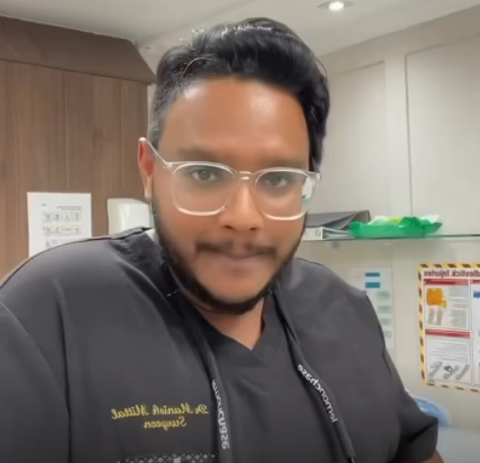
Dr Manish Mittal
Hair transplant surgeon at Mittal Hair Clinic, London.
- GMC number: 7494779
- Member: IAHRS
- Experience: Over 2,000 patient cases
- Clinic: Mittal Hair Clinic, London EC1M 6AW
- Registered: Care Quality Commission registered
- Founded: 2018
Book your hair transplant consultation in London
➡️ Discuss graft numbers, hairline design, costs, recovery and expected results.
Hair Transplant at Mittal Hair Clinic
London has many clinics offering hair transplants — but not all clinics operate the same way.
Some clinics are surgeon-led, with careful planning, controlled graft placement, and strong aftercare.
Others are volume-driven, with a heavy sales approach, rushed procedures, and inconsistent outcomes.
Wondering if it hurts? Find out what to expect here.
At Mittal Hair Clinic, our approach is focused on:
- planning first, surgery second
- conservative, natural hairlines
- realistic graft targets
- long-term hair stability (not just quick cosmetic improvement)
An often-asked question Dr Mani gets is
“How many grafts are needed for a hair transplant?”
Many people do not realise that hair transplants are permanent and ask
“How long does a hair transplant last?”
A major concern that new patients have is
“Does a hair transplant hurt?”
If you’re unsure whether you’re suitable for surgery, or you want a second opinion, contact us.
Quick Summary — Hair Transplant Options
Every patient has different hair loss patterns and different donor area strength — which means there is no “one best method” for everyone.
FUE Hair Transplant (Most Popular in London)
FUE (Follicular Unit Extraction) is the most commonly requested technique in London today. Grafts are extracted one-by-one from the donor area and implanted into thinning or bald areas.
Most patients choose FUE hair transplant London because it allows natural density with minimal visible scarring.
FUT Hair Transplant (Strip Method)
FUT (Follicular Unit Transplantation) uses a fine strip removal method. It can be excellent in certain cases where maximum graft yield is needed.
Specialist Transplants (Eyebrow / Beard / Scar Repair)
Some patients also explore:
What Is a Hair Transplant? (How It Works)
A hair transplant is a permanent hair restoration procedure where healthy follicles are taken from a resistant donor area and moved to thinning or bald areas.
Donor Area Explained
The donor area is typically the back and sides of the scalp, where hair follicles are genetically more resistant to hair loss.
The strength of your donor area affects:
• how many grafts you can safely extract
• how much density can be added
• whether you are better suited for FUE or FUT
FUE Hair Transplant London (Our Most Requested Treatment)
FUE is the preferred option for many patients because it typically:
- avoids a linear strip scar
- offers fast healing of the donor area
- works well for hairline restoration and crown work
Step-by-Step FUE Procedure
A typical FUE journey includes:
1) Consultation + suitability assessment
Hair loss type, donor strength, goals and long-term plan.
2) Hairline planning and design
Natural age-appropriate hairline mapped based on facial proportions.
3) Donor extraction
Individual grafts removed in a controlled pattern to avoid donor thinning.
4) Channel opening / placement planning
Angles and direction matter for naturalness.
5) Graft implantation
Careful placement by zone:
- hairline singles
- mid-scalp density
- crown pattern
 Learn more:
FUE hair transplant
FUT Hair Transplant London (When It’s Recommended)
FUT is sometimes overlooked, but in expert hands, it can be excellent.
When FUT Can Be Better Than FUE
FUT may be recommended when:
- you need a high number of grafts
- your donor area is limited
- you want maximum graft yield
- you want to protect donor supply for future sessions
Does FUT Leave a Scar?
Yes — FUT leaves a linear scar. However:
- it is typically thin and concealed by surrounding hair
- many patients are comfortable with this trade-off
Learn more:
FUT hair transplant
How Much Does a Hair Transplant Cost in London?
Cost is one of the biggest deciding factors — but it’s also where many patients get misled.
London pricing varies dramatically depending on:
- surgeon involvement
- graft count
- technique used
- clinic reputation
- aftercare support
- whether it’s a “package deal” chain clinic
What Are “Grafts”?
A graft is a natural follicular unit that can contain:
- 1 hair (ideal for hairline)
- 2 hairs
- 3+ hairs (used for density behind hairline)
This is why graft planning matters more than just “how many hairs”.
 Tracing out the area for treatment and then the result:
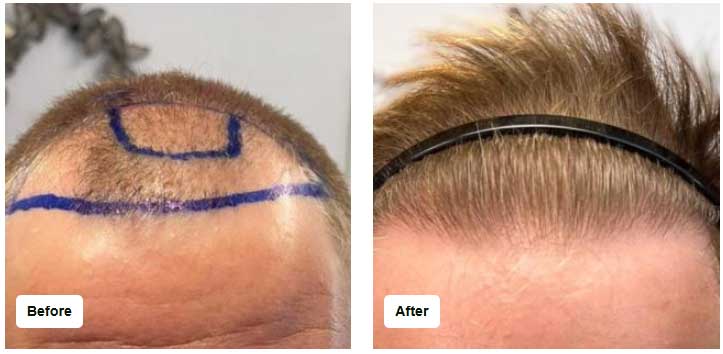 Hairline transplant before and after
What Determines Hair Transplant Cost?
Your quote is influenced by:
- number of grafts required
- complexity (hairline, crown swirl, previous surgery)
- density goals
- whether you need FUT or FUE
- time required
Why Cheap Hair Transplants Often Go Wrong
Common issues with bargain clinics include:
- overharvesting donor area
- unnatural hairline design
- inconsistent graft survival
- poor aftercare
- “too many grafts promised” sales tactics
Read more: hair-transplant-cost
What You Should Look For in Before/After Images
Look for:
- natural hairline shape
- correct temple recession
- realistic density
- consistency in lighting and angles
- long-term follow-ups (not just 2–3 months)
See full transformations: /case-studies/
Recovery Timeline — What to Expect After Surgery
Recovery is one of the most misunderstood parts of hair transplant surgery.
Many patients are surprised by:
- early redness
- scabbing
- shedding phase (shock loss)
But these are normal — and part of the process.
Days 1–7 (Healing & Washing)
- swelling and tightness may occur
- scabs form around implanted grafts
- careful washing begins early under guidance
Weeks 2–4 (Shedding / Shock Loss Phase)
This is normal.
The hairs often fall out — but follicles stay inside and begin regrowth later.
Months 3–6 (Visible Growth Begins)
New hair gradually appears.
Density increases month-by-month.
Months 9–12 (Final Result)
Final thickness and maturity develops.
Crown results may take longer.
Who Is a Good Candidate for a Hair Transplant?
A hair transplant is not just about getting hair back — it’s about long-term planning.
Ideal Candidates
You may be a good candidate if:
- your hair loss has stabilised
- donor area is strong and healthy
- expectations are realistic
- you have enough donor supply for long-term needs
Why Many Patients Are Turned Down for hair transplant Surgery
One of the biggest misconceptions about hair transplants is that everyone with hair loss is a suitable candidate. At Mittal Hair Clinic, we regularly advise patients not to proceed with surgery when we believe the result may not be in their long-term interests.
In fact, between 70% and 80% of people who enquire with the clinic are not offered a surgical procedure.
Reasons may include:
-
- hair loss that is still rapidly progressing
- weak donor area density
- unrealistic expectations
- age-related concerns
- medical or scalp conditions
- insufficient long-term donor supply
For some patients, medical treatment, monitoring, or a delayed approach may be safer and more appropriate than immediate surgery.
Patients Who Should Be Cautious
Extra caution required if:
-
-
- your hair loss is still aggressive (young age)
- donor supply is weak
- you have active scalp conditions
- you expect teenage hairline density instantly
-
Hairline Design & Natural Results
This is where great clinics win.
The goal is not just “hair”.
It’s a natural-looking hairline that works with your:
-
-
- age
- face shape
- future hair loss pattern
- ethnicity/hair characteristics
-
What Makes a Hairline Look Natural?
-
-
- irregularity (no straight sharp lines)
- soft transitions at the hairline
- correct angles and direction
- appropriate density at the front
-
Why Overly Low Hairlines Fail
A low hairline might look good temporarily, but in future it can:
-
-
- look unnatural as you age
- consume too many grafts early
- leave insufficient grafts for crown and mid-scalp
-
Risks, Side Effects & Safety
A hair transplant is generally safe when performed correctly, but like any medical procedure, it has risks.
Common Side Effects
-
-
- swelling
- redness
- itching
- temporary numbness
- scabbing
-
Potential Risks
-
-
- infection
- excessive shock loss
- poor graft growth
- visible donor thinning (from overharvesting)
- unnatural direction or density
-
How Mittal Hair Clinic Reduces Risk
-
-
- careful donor management
- sterile conditions
- surgeon-led planning
- structured aftercare and follow-up
-
Choosing the Best Hair Transplant Clinic in London
If you’re comparing clinics, ask these questions.
What You MUST Check
Who is the surgeon?
Is the surgeon GMC registered?
Do they show consistent, real results?
Do they discuss long-term planning?
What aftercare is included?
Red Flags
 Sales-led consultations
“Unlimited grafts” marketing
Copy-paste WhatsApp quotes
No discussion of donor limits
Unclear surgeon involvement
Why Choose Mittal Hair Clinic?
Patients choose Mittal Hair Clinic because they want:
-
-
- natural results
- careful planning
- surgeon accountability
- and a clinic that focuses on quality, not volume
-
Surgeon-Led Care (Not a Production Line)
Your result depends on:
-
-
- design
- precision
- graft handling
- placement strategy
-
These are not areas where shortcuts work.
Consultation → Procedure → Aftercare
From first consultation to final result, the journey is supported.
View results: /case-studies/
Learn methods: fue-hair-transplant | fut-hair-transplant
Aftercare: Our range of videos on hair transplant aftercare
Ready to take the next step?
Discover how many grafts you may need
Understand your cost and suitability
Get a surgeon-led plan for natural results
FAQs — Hair Transplant London
How long does a hair transplant last?
A hair transplant is designed to be permanent because transplanted hairs come from donor zones resistant to hair loss.
Does a hair transplant hurt?
Local anaesthetic is used. Most discomfort is mild and manageable after the procedure.
When can I return to work?
Many patients return to work within 3–7 days depending on healing and job type.
When will I see results?
Initial growth begins around 3–4 months, with the final outcome typically seen at 9–12 months.
How many grafts will I need?
This depends on hair loss pattern, desired density and donor strength — it must be assessed professionally.
Book Your Hair Transplant Consultation in London
If you want a result that looks natural now — and still looks natural years later — the most important step is a proper consultation and plan.