+44 (0) 203 488 9897






Dr. Norman Orentreich: The Pioneer of Modern Hair Transplantation

Hair transplantation today is a sophisticated medical art, restoring not just hair but also confidence. At the heart of this journey is Dr. Norman Orentreich, a visionary dermatologist who pioneered the first scientifically validated hair transplant techniques and laid the foundation for the thriving industry we know today.
The Early Years and Orentreich’s Breakthrough
In the early 1950s, male pattern baldness was considered irreversible. Wigs, hairpieces, and unproven potions were the only options for men seeking to restore their hair. Everything changed in 1952, when Dr. Orentreich performed the first modern hair transplant in New York City. His innovative approach—moving small punch grafts of hair-bearing skin from the permanent donor zone (the sides and back of the scalp) to balding areas—demonstrated that transplanted hair retained its characteristics from the donor site.
This discovery, known as “donor dominance,” became the foundation of all future hair restoration techniques.
Founding the Orentreich Foundation for the Advancement of Science
Beyond clinical practice, Dr. Orentreich was deeply invested in research. He established the Orentreich Foundation for the Advancement of Science (OFAS), a non-profit organization dedicated to medical and scientific progress. The foundation supported groundbreaking studies in dermatology, hair biology, aging, and cancer research, extending Orentreich’s influence beyond cosmetic procedures.
Inspiring Future Generations of Surgeons
Dr. Orentreich’s work inspired a new wave of surgeons and researchers to refine and improve hair transplant techniques. His early “punch graft” procedures, while groundbreaking, often produced a “pluggy” or unnatural look due to the size of the grafts. Over the decades, doctors built upon his concepts, introducing methods such as:
- Mini- and micro-grafts in the 1980s and 1990s, which produced softer, more natural hairlines.
- Follicular Unit Transplantation (FUT) in the mid-1990s, pioneered by Dr. Robert Bernstein and Dr. William Rassman, which involved transplanting naturally occurring follicular units for a more seamless appearance.
- Follicular Unit Extraction (FUE), which rose to prominence in the 2000s, allowing for scarless donor harvesting and faster recovery.
Every major advance in hair transplantation owes a debt to Dr. Orentreich’s original concept of donor dominance and permanent hair restoration.
How Hair Transplant Techniques Have Improved
Modern hair transplants bear little resemblance to the early procedures of the 1950s. Today’s results are virtually undetectable due to:
- High-density grafting with individual follicular units.
- Precision surgical tools and robotics (e.g., ARTAS, Neograft) that allow minimal scarring.
- Improved hairline design based on facial symmetry and natural growth patterns.
- Combination therapies, such as PRP (platelet-rich plasma) and medications, that enhance graft survival and overall density.
Modern patients enjoy faster recovery, higher success rates (95%+ graft survival), and lifelong results that look and feel natural.
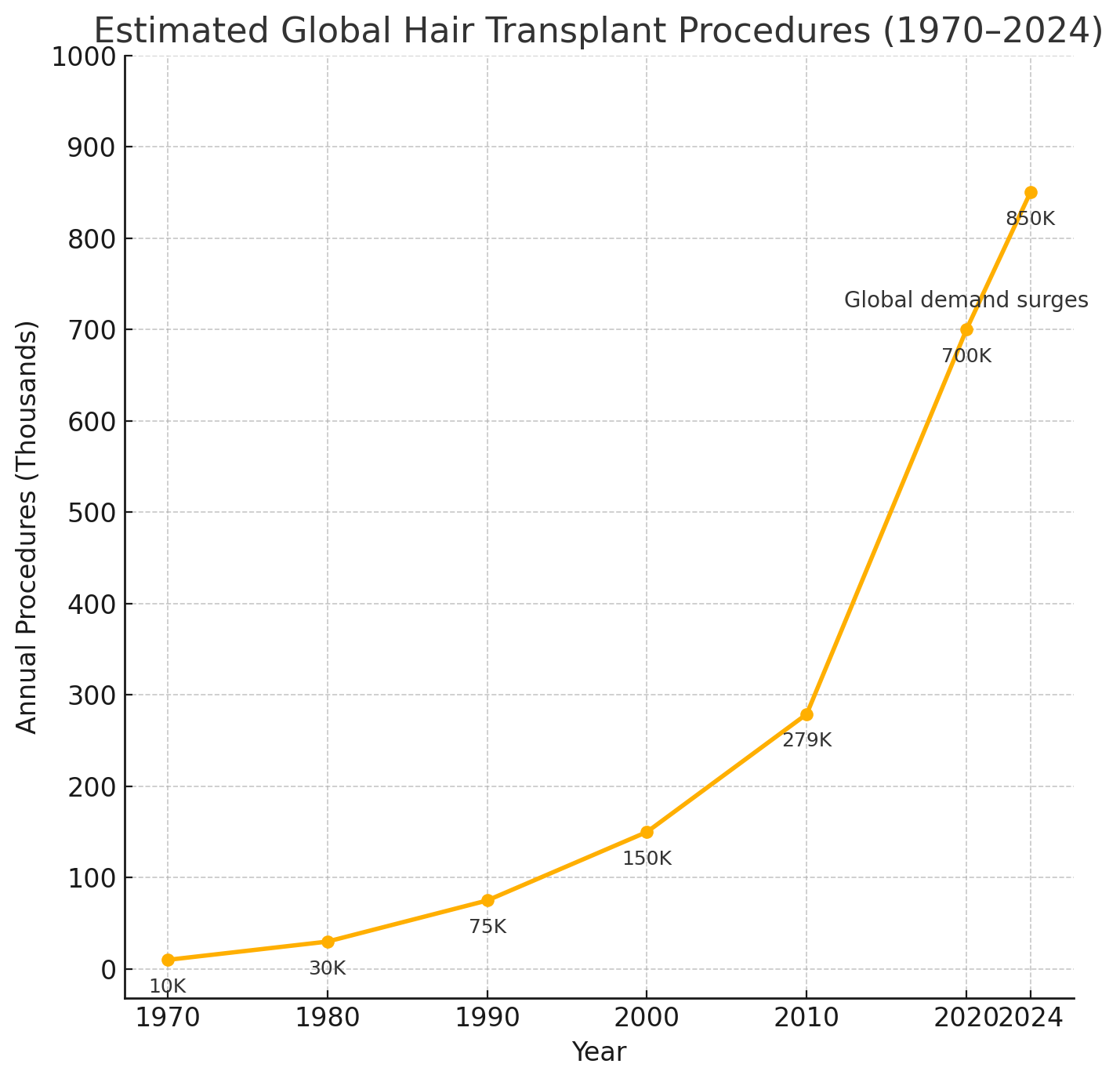
Hair Transplant Statistics Over the Past 50 Years
- In the 1970s, only a few hundred hair transplants were performed worldwide each year due to the limited awareness and primitive techniques.
- By 2010, the International Society of Hair Restoration Surgery (ISHRS) estimated over 279,000 hair transplant procedures were being performed annually across the globe.
- In 2022, that number climbed to over 700,000 procedures worldwide (ISHRS Global Census 2022), representing a 40% increase in just the past decade.
- The global hair transplant market was valued at $5 billion in 2022 and is projected to surpass $30 billion by 2030, driven by advances in FUE, robotics, and increasing social acceptance.
The Legacy of Dr. Orentreich
Dr. Norman Orentreich’s groundbreaking work not only revolutionized hair loss treatment but also elevated cosmetic dermatology as a whole. Every modern hair restoration technique—from the earliest FUT strips to today’s robotic FUE—builds upon the principles he introduced.
His vision transformed hair transplantation from a fringe experiment to a mainstream, life-changing procedure for millions of men and women worldwide.